Return to page : Philippe d'Horrer--------Russian lineage family tree-------Map of Ukraina
Next page : Russian Revolution /2
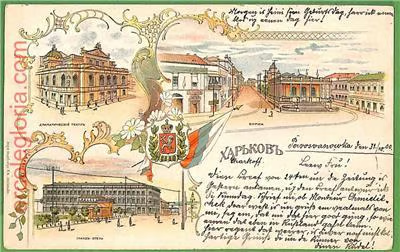 He married in 1874, in Kharkov, Katia (= Catherine) Viatcheslvana Passek(1), born in 1856 and famous beauty of Kharkov. The Passek were the cadet branch of the dukes of Moldova Kandemir (according to T. P. Passek’s Memoirs). It was an advantageous marriage because Catherine brought as a dowry the estate of Demiakovka, not far from Okhtyrka, in Ukraina, a region highly prized by the Russian nobility in the 19th century, the neighboring district of Bogodukhov.
Unfortunately, in 1889 Joseph Ph. d'Horrer played and lost his estate, after which the d'Horrer family owned only a house in Kharkov where they rented the first floor to live. Iossif, very bitter and became seriously ill, paralyzed, spent the last fifteen years of his life in a dormitory, without any contact with his friends and relatives, if not his brothers from the Masonic lodge. He died in 1900. His widow remarried the doctor who treated her husband, Bronislav Grigorievich Prjevalsky, and died in 1940 after all her children, alone, in the clinic run by her second husband. In 1917, after the February Revolution, she received a letter from France, probably from Arsène d'Horrer, transmitted it to her son Georges who replied, but without response. (DOC Letter from Sofia d'Horrer, July 15, 1993)
They had six children, including four sons: Georges (1875-1917), Sergueï (1877-19412), Evgenia (1879-194?), Vera (1885-1918) and Boris (1891-1937). To find one’s bearings more easily in the repetition of first names in the two surviving lines, note the alternation of Georges/Alexeï in the descent of Georges'descent, and the Joseph/AlexeÏ in Alexeï's descent..
1° The Count Georges Iossifovitch d'HORRER, founder of the elder branch, established mainly in Siberia, who follows
2° The Count SERGUEI (Serge) Iossifovitch d'HORRER (1877-1942)

He was born on August 30, 1877, on the family estate of Demiakovka, near Kharkov. After having conceded to his older brother Georges in his love for Olga Delarue, he went to study technology in Germany, financially helped by Georges. Conversely, after Georges' death, Sergueï helped financially his widow and his four children.

Graduated from the Kharkov Institute of Technology, he became a professor of thermodynamics specializing in thermal engines and turbogenerators. His memory is still vivid in this Institute, and the library still has works by Sergueï d'Horrer such as "The latest methods for calculating steam turbines", "Technical thermodynamics", etc. (DOC 28 : Manuscript "Steam Turbines", by Serguei d'Horrer").
He will later contribute to the development of the mechanical industry in Ukraina through diesel, then work at the Moscow Aviation Institute.
He has never been involved in politics or belonged to any party whatsoever. But having his two brothers Georges and Boris in rebellion against the regime, he was very worried about his family and, out of caution, he gave up his title of count. He went to take refuge in Rostov-on-Don (southern Russia, near the Sea of Azov). But the regime was reconciled with the "irreplaceability" of the specialists of the Ancien Régime, so that it was spared a few years. The family kept a low profile, with a few odd jobs to get through this difficult time. He was even able to give lectures, but he had the imprudence to praise foreign technologies.

He was arrested during the great Stalinist purges of 1937. The conditions there were inhumane; the prisoners were working very hard. He died of hunger on December 7, 1942 in the famous Karaganda Gulag (KARLAG), where 800,000 people were prisoners... But in 1940, he could meet his wife at the camp, which was an extremely rare privilege, and shortly before his death, he had been able to send a letter to his daughter Olga, in which he asked for a small piece of bread... I could read this letter in Moscow, she is currently at her granddaughter Elena d'Horrer’s.
1/ The Count OLEG Sergueievitch d'HORRER, born around 1916, committed suicide on May 11, 1935, aged 19. He completed his chemistry studies very young at the University of Leningrad. But the assassination of Kirov was the beginning of the great purges, there was a resurgence of terror and, shortly before his father’s arrest, he was dismissed from the Komsomol, subjected to harassment by his comrades, then expelled from the university. He then went to his laboratory and committed suicide by poisoning himself.
After the Revolution, the Doroshenko family was well-off. But she moved away from the d'Horrer family, three members of which had already died at the hands of the communists. And after the arrest of his little brother Boris d'Horrer, all contact was lost with Eugénie and her family.
4° VERA Iossifovna d'HORRER was born in 1883 on the property of Demiakovka. She also studied medicine and became a surgeon in Moscow. She married the prince (Sergueï Pietrovitch?) OUKHTOMSKI of whom she had first been the mistress, and would have had a son, who died in the United States around 1953. He wrote in 1960, from Florida, to Olivier d'Horrer to inform him of the death of his wife.
In 1918, she accompanied him in the civil war alongside the White army, opposed to the Revolution, where her husband was a colonel. In 1919/1920, he fell ill with typhus and Vera spent her days and nights by his side. But, having herself caught the typhus, she died.
5° The Count ALEXEÏ Iossifovitch d'HORRER
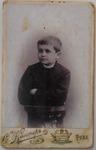 Graduated in law and medicine, he was a lawyer like his older brother Georges. But, unlike all of Horrer’s others, his political ideal was left-wing. He was a revolutionary socialist, so much so that during his youth he knew sometimes exile, sometimes the prisons of the tsar. And it is thanks to the deposits paid by his brother Georges that he was released.
 In Vologda, he met a young revolutionary socialist who was also exiled, Victoria Vladimirovska Dilievska, born in 1886, daughter of a Polish aristocrat. He married her in 1910 and they lived in Vologda. In 1911, Stalin, still unknown, spent two weeks with d'Horrer. In 1912, on his last release from prison, Alexei went to join his brother George in Ashkabad (Turkmenistan), where he worked as a lawyer.
The Bolsheviks had little support for Turmenistan, and in July 1918 the mobilization order provoked the anti-Bolshevik uprising of Ashkabad, led by the right-wing socialist-revolutionary (Menshevik) Funtikoff, with the presence of Alexei d'Horrer, finally joined by the Turkmen tribal chiefs, those who had tried to escape his older brother Georges d'Horrer (see next page).
This group of insurgents created a "Provisional Transcaspian government" linked to the English and Turkish forces, led by Funtikoff. Alexei d'Horrer became the Minister of Justice and in this capacity he was responsible for the case of the 26 People’s Commissars of Baku (2). And he became secretary of the field court at the headquarters of the commander in chief of the volunteer army. The Turkestan Red Army finally defeated them a few months later, and d'Horrer had to flee.
Alexei d'Horrer and Victoria Dilievska are at the origin of the branch of Tula. They had three children ; the first two entered the Communist Party. But as their grandchildren told me in person when I met them in Moscow, our family was handicapped by their nobility - moreover mentioned on the identity card - and registration with the Party represented nothing other than the possibility of pursuing higher education, to obtain a job in accordance with his/her qualifications, to be a soldier and to have a career.

He joined the Communist Party in 1936, took part in the Finnish War in 39, was frozen and his toes were amputated ; he then joined the People’s Volunteer Corps and took part in the defense of Moscow against the Nazis. His last letter from the front dates from 1941. It seems that he died as a result of his wounds, aged 31.


He then had as a partner Anna Gavrilovna GORIAINOVA, born RAZINA (1916-2009). With her, he had a daughter, Lioubov, born in 1942.
 She died on 11 October 2001 in Toula. They have six children: Igor (1936), who died in a car accident in 1961, Victoria (1937-2019 and mother of Natalia), Evguenia (1945), Tatiana (1947), Olga (1949) and Yulia (= Julie), all married.
As a member of a group of counter-revolutionary young people, Boris was arrested on 11 June 1937, convicted on 12 November and executed on 19 November 1937. He was rehabilitated on June 14, 1963.
NOTES
1/ Passek: Noble family from Bohemia. Danila Ivanovich Passek took Russian citizenship in the 17th century after the annexation of Smolensk by the Russians.
2/ From April 26 to July 31, 1918, there existed in Baku (Azerbaijan) a government of Bolsheviks and Socialist-Revolutionaries. Their leaders were called Commissars . This government will be overthrown by English and Turkish soldiers and the commissioners were arrested by the English. Funtikoff (head of the provisional government of Zakaspi) went to their prison, presented a document signed by the Minister of Justice Alexeï d'Horrer according to which the English authorities of the prison were to entrust him with these Commissars, and locked them in a train; it stopped in the middle of the countryside, and the 26 Commissars were executed by a firing squad between the stations of Pereval and Akhcha-Kuyma on the Transcaspian Railway by Turkmen SR soldiers of the Ashkhabad Committee.