PHILIPPE d'HORRER and his last son, WLADIMIR
First lieutenant, like his brothers Joseph and Alexander, in the 3rd Swiss regiment at the service of Naples, he later took up service in Russia. "Cornette" (= lieutenant) in the Bosissoglebsk Lancers Regiment (1847), then in the 7th Ukrainian Cavalry Regiment (1852), in the Hussards regiment of Belarus in 1853, he was appointed captain of Staff (1855) then cavalry captain (1859). He received as his only decoration the order of Saint-Stanislas, 3rd degree. (DOC 37 : Detailed record of the military service of Philippe d’Horrer in the service of Russia). Sick, he retired on August 17, 1859.
He had taken the oath of Russian subjection on May 4, 1848. He was the owner of a 250-hectare estate in Little Russia, Bielgorod district, Kursk government, which he had received from the tsar when he took citizenship of the Russian Empire and the Orthodox cross. We will often find members of our family in this region of Kursk (Russia) and Kharkov (Ukraine), cities nearby, but today separated by the border.
Twice married, and before 1841 he married Maria Stepanovna DZHUNKOVSKAYA (1), who died in this field in 18... and with whom he had four children. She was the daughter of Stepan Semeanovitch Dzhunkovsky, a private advisor.
In a second marriage, he married, before 1862, Antonina Ippolitovna DORGOBUZHINOVA (2) . They had a son, Wladimir.
From the first bed were born:
1° MARIA Philippovna, countess d'HORRER, born on May 29, 1842, married to N. KUDRICHEVSKI. Their children Yuri (1862), Nicolas (1869) and Olga (1871), are mentioned in a letter in my possession from Wladimir to Arsène d'Horrer.
2° ANNA Philippovna, countess d'HORRER, born on May 10, 1843, married to N. KROUTOFF (3).
3° Count IOSSIF (= JOSEPH) Philippovitch d'HORRER, who follows.
4° Knight MIKHAIL Philippovitch of HORRER, dead as a child.
5° Count WLADIMIR Philippovitch d'HORRER, on whom I will dwell for a moment, because he played an important role in the family and as a politician. Wladimir d'Horrer (1862-1909) was born in Kharkov, Ukraine, shortly before Wladimir d'Horrer (1862-1909) was born in Kharkov, Ukraine, shortly before the death of his father Philippe. He was raised by his mother and her brother,Vladimir I. Dorogoboujinoff, State Councilor, Privy Councilor, Consul in Jerusalem. This is perhaps why he inherited the Razumno entailed estate of the Dorogoboujinoffs, which included 38 men and 37 women in serfdom. He had been baptized Orthodox, the religion of his parents. But he was going to lose his title of count, since it had been granted on condition that one remained in the Catholic faith. This is why a special decree of Tsar Alexander III of December 9, 1892, recognized the title of count of the Russian Empire to him as well as to his half-brother Joseph, but not to Michel d'Horrer, who was already dead. This is how our family is found in the Registers of the Russian nobility with this title.
He studied at the Tsarevitch Nicolas Lyceum in Moscow, obtained a degree in history and philology from the University of Moscow, entered the Ministry of the Interior on July 21, 1885, and became an itinerant official for special missions. On May 8, 1886, he became College Secretary (=Ministry), in the minister's office. On October 7, 1889, he became titular counselor at the Ministry of the Interior.
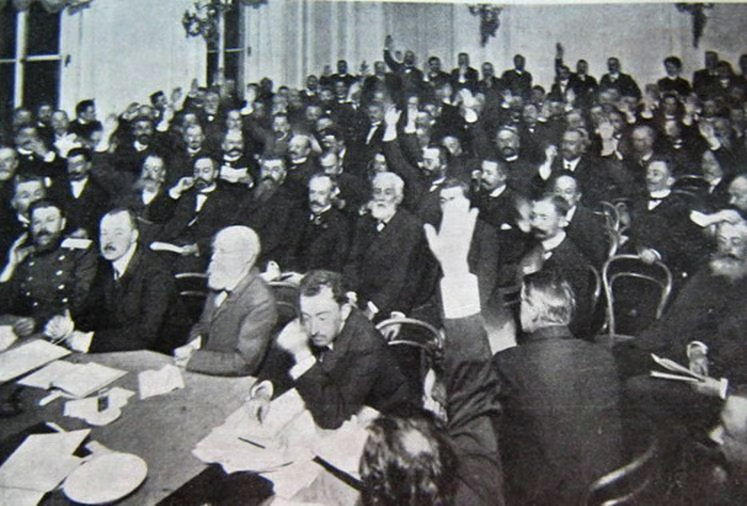 A zemstvo meeting, 1905
Having returned to his lands a few years later, he found himself there when the Zemstvos began to be instituted. (Comparable to our general councils, the "Zemstvos" were provincial assemblies of the Russian Empire representing the local nobility, notables and peasants. But the nobility exercised a preponderant influence there. The Marshal of the Nobility presided over the assemblies.) He therefore participated in the elaboration of the "Regulations on the heads of Zemstvo". In 1890, Vladimir d'Horrer was appointed Marshal of the Nobility, a function both legal and administrative including notably the control of local peasant justice in the rural cantons, always in the district of Bielgorod, government of Kursk. On January 2, 1890, he was made Knight of Saint-Anne of 3rd class.
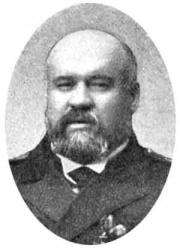 Wladimir d'Horrer then convened a meeting of the Kursk nobility, which decided to send a deputation to the Tsar, tasked with assuring him of the loyal support of the nobility and landowners and protesting against the plans to convene a Constituent Assembly. It was Wladimir d'Horrer himself who presented this address to Nicholas II on June 20, 1905. This action encouraged the nobility, who felt lost, and a noble social movement developed.
In October 1905, faced with the revolutionary riots in Kursk, he organized a counter-demonstration with a prayer service for the Tsar, deprived progressive students of Moscow University of the scholarships that the nobles had granted them, and the Kursk nobility excluded from its ranks the liberal nobles who had signed "the Vyborg Appeal", calling for a tax strike and refusal of military service. On November 17, 1905, he was elected a member of the Council of the All-Russian Union of Landowners.
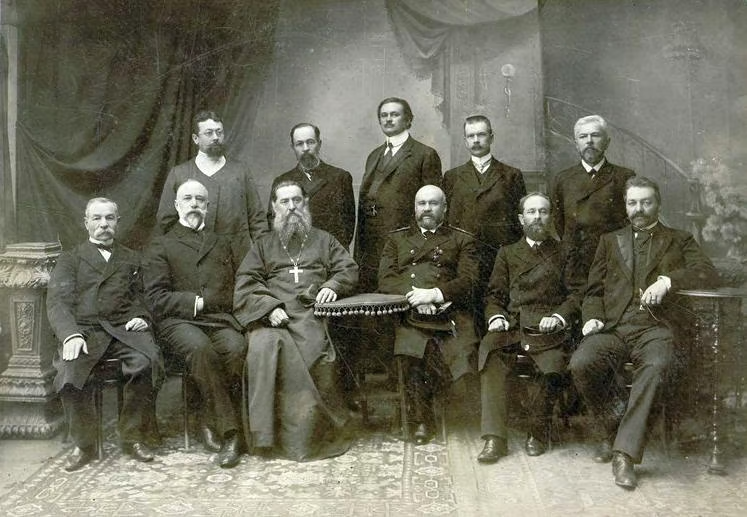 In 1907, he was elected deputy to the IIIrd State Duma (= Legislative Assembly of the Empire) for the Kursk government (in the photo he is the 3rd from the right). This was a region where the influence of large landowners remained intact. (Doc 25. Concern of General Bogdanovitch's wife at the election of Wladimir d’Horrer as Vice-President of the Imperial Duma (1905) ). He was a member of the right-wing faction and was the party's office president. In the summer of 1908, he was elected a member of the main council of the Union of the Russian People a monarchist party advocating the defense of tsarism, orthodoxy, the fight against Freemasonry, and open to a redistribution of land to peasants, but a limited one. The objectives of his party were to "preserve the prominent place of landowners", "the restoration of the purity of the Orthodox faith", and "the preservation of the integrity and unity of the autocratic Tsarist Empire".
The objectives of his party were “to preserve the prominent position of landowners,” “the restoration of the purity of the Orthodox faith,” and “the preservation of the integrity and unity of the Tsarist autocratic empire.” (DOC 31 : The monarchist convictions of Wladimir d’Horrer).
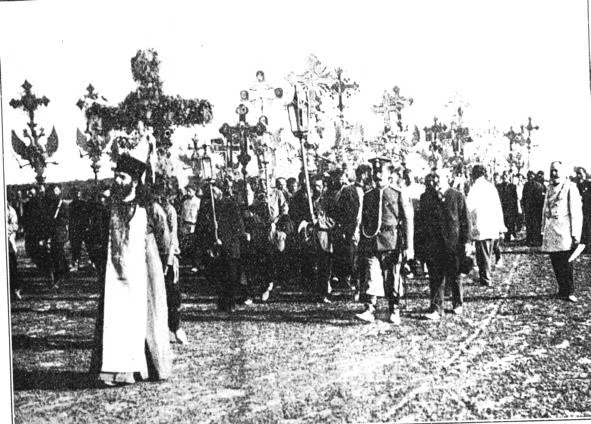
Unfortunately (the darker side of the character), he was also one of the leaders of an extreme-right monarchist organization, The Black Hundreds. This “pre-fascist” movement had a nationalist, ultra-monarchist, and deeply antisemitic ideology.
A procession of the Black-Hundreds in 1907
He condemned pogroms because such massacres did not solve the “Jewish problem,” but his program aimed to forbid Jews any possibility of owning property, engaging in trade, or controlling the press, because, as he said, “one must choose: either the pleasure of the Jews, or Great Russia!” (DOC 32 : Proposals by Wladimir d’Horrer on the best way to combat the Jews [quotations])..
Count Wladimir d’Horrer died of pneumonia, childless, on August 16, 1909, after a long illness, and is buried in Razumno, in the family crypt of the Dorogoboujinoff-d’Horrer family. Unfortunately, the immense tank battle of Kursk in 1943, along with the passage of time, caused the Razumno estate—together with its Church of St. Nicholas and the family crypt it housed—to disappear.

He married Olga Nikolaevna LYUBIMOVA (4) , the sister of a school friend and the daughter of Nikolai A. Lyubimov, formerly a professor at Moscow University, then a member of the Council of the Minister of Public Instruction, and finally promoted to Privy Councillor in 1886. Her mother was Ekaterina Dmitrievna Balck.
NOTES
1/DZHUNKOVSKY, : Джунко́вскийa : noble family known since the mid-18th century, registered in the second part (military nobility) of the registers of nobility of Kaluga and Chernigov. It was most likely his sister Elisabeth who married, around 1840, Jean Karlovitch de Rachette. Both families maried 3 times in one generation ! Toward the end of the 19th century, a Dzhunkovsky served as adjutant to Grand Duke Sergei, brother of Nicholas II and husband of Grand Duchess Elisabeth, the Tsarina’s sister, later canonized.
2/ She was the sister of Vladimir Dorogobuzhinoff, State Councillor, then Privy Councillor, a member of the Council of the Ministry of the Interior, and Russia’s first consul in Jerusalem.
.