Russian Revolution / 2: Georges d'Horrer
Next page : Other persecutions in the USSR

Invalid since the age of 16 following a stupid bet, he could not walk without a cane or crutches. He was a deputy prosecutor in Stariy-Askol, near Kharkov, for one year. (DOC 21 : Georges Iossifovitch d'Horrer's passport ).


After his marriage, he settled in Lithuania, on the estate of Lichtsiany, near the city of Rossieny, which he had bought at auction while going into debt. He worked there for two years as a lawyer but, to pay his debts, he was forced to go to Turkestan, where he became a lawyer with the railways and became a renowned lawyer.
The d'Horrer family was not rich since his father, Iossif, had played and lost the Demaiakovka estate to cards in 1889, and Lichtsiany was lost following the advance of German troops during the First World War. But financial ease returned in 1916-1917: Georges d'Horrer received 150,000 rubles from the Tsar’s bank and had shares in oil fields where large deposits were found.
Georges d'Horrer belonged to a social-bourgeois pro-socialist party of the Kerensky tendency, therefore opposed to the Bolsheviks and the Marxists. The Bolsheviks had little support in Turkestan, and the mobilization order of the 14-18 war caused several uprisings, led by the right-wing socialist-revolutionary Funtikoff, with the presence of Alexei d'Horrer (Georges's brother), finally joined by the Turkmen tribal chiefs.
After the revolt of the Turkmen in Tendjen and their defeat, the rioters raised against the Tsar addressed Georges d'Horrer asking him to save them; certainly it was not easy for a Russian tsarist lawyer to plead in favor of people who rose up against the "Old Regime". He nevertheless won this lawsuit and received for it an incredibly high fee (20,000 gold rubles). Many rioters were freed, others saw their sentence softened.
In the general chaos which followed the 1917 revolution, numerous provinces proclaimed their independence and a lot of self-proclaimed "governments" appeared on the territory of Russia: the Baltic countries, Ukraine, for example, gained their independence. 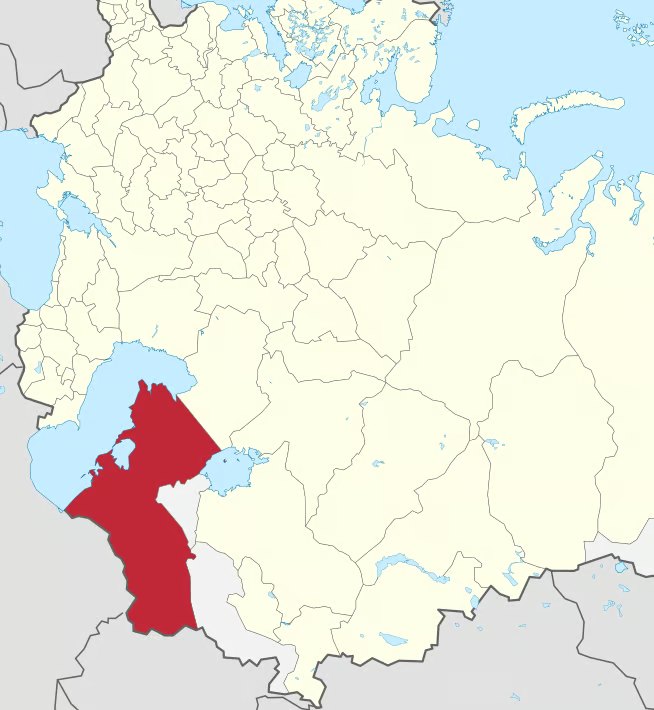 In the south, a short-lived Transcaspian Republic was formed, on the current territories of Turkestan, Turkmenistan, Kazakstan, Kyrgyzstan and Uzbekistan. And they went to ask Georges d'Horrer to be one of its principal plenipotentiaries, the assistant of the General Commissioner of this government (1) in recognition from the population. He accepted this position, even if it meant moving from his very large income as a considered lawyer, to a slight emolument. In Ashchkabad, as elsewhere, the Soviet Russian governing bodies were liquidated to form a provisional social-bourgeois government.
But the October Revolution of 1917 transformed this party into a resolutely counter-revolutionary and anti-Bolshevik party, and the revolt spread to the entire Trans-Caspian region.
This revolt was quickly defeated by the Reds and Georges d'Horrer was dismissed for "anti-popular activities" and arrested on November 1, 1917, for having taken an active part in the counter-revolutionary uprising of October 28, 1917.
The trial
This episode seen by a Bolshevik will be reported by Soviet propaganda in 1935 (DOC-22: A naive revolutionary story about Georges d'Horrer ( d'Horrer’s presentation as a 'German' is due to the fact that, for these men with little or no culture, any person dressed in Western clothing was German, the European nationality most represented in these regions... yet the Germans were the enemies during this war).
His trial, early December 1917:
The newspaper "Turkestan News" of December 5/9, 1917 recounts in detail his trial (Doc 27  Red the full article about Georges d'Horrer's trial (63.82 Ko). Here is the verdict:
°°To the question: "Is Dorrer guilty of having contributed by his actions to the shooting at the revolutionary soldiers in the fortress?" , the jury said "not guilty."
°°To the question: "Did he contribute to the disarmament of the 1st and 2nd Siberian Regiments (one of which was white and the other red), knowing that this could have caused the carnage?" They replied: "guilty, but deserves leniency."
°°To the question: "Is he guilty of having contributed to arming groups of counter-revolutionary citizens of the population of Tashkent?" , the jury said "guilty."
Prosecutor Toboline requested 20 years of imprisonment, but he was sentenced to 3 years and 4 months in prison.
The circumstances of his death (period account), mid-December
"On December 13, Tashkent hosted a large demonstration of the indigenous inhabitants of Turkestan, organized by moderate political forces in support of the autonomy of Turkestan. A meeting was held with the participation of representatives of the indigenous population (they represented two thirds of the total number of representatives) and Russians (they constituted one third). ... This grandiose procession with the participation of several thousand people was formed in the ancient part of the city. The protesters, passing through a new part of the city and approaching the Tashkent prison, demanded the release of political prisoners.
Thus delivered, the Count d'Horrer got into the car and supported the protesters. [...] But when the procession returned to the old town, it found itself face to face with armed Bolsheviks. Machine gun bursts caused panic in the ranks of the protesters. The Count’s car was surrounded, and the Count himself, together with General Kielechko, the governor of Samarkand, lawyer Drujkine, brother of the Transcaspian commissioner, Colonel Beck and Captain Rusanov were taken to the fortress. All were killed in the most cruel way: their cries could be heard from the fortress from early evening until two o'clock in the morning. The Bolsheviks Tobolin, Perfilyeff, Kolesoff, Stasikoff conducted the torture.
After his death, new persecutions
But the faithful Turkmen then helped his wife, Olga, to flee Ashkabad where she was threatened, and hid her with her children. During 7 years of famine, they ensured their livelihood at the risk of their lives, claiming to be debtors to Georges d'Horrer and never saying their name.
In 1924, new persecutions took place, and the whole family as well as that of Alexei, hidden in a cattle car, left for the region of origin of the d'Horrer, in a farm near Kharkov, Ukraina, where she will live with Olga’s older sister (Delarue)-d'Horrer and her family, the Bitch-Lubensky. In 1927, they were deprived of their civil rights as aristocrats.

NOTES
1/ At that time, there was no longer a credible central government in Russia and, in the confusion, provisional local governments were formed, sometimes linked to the socialist central power of Kerensky, sometimes dependent on the anti-revolutionary English and Turkish armed forces. Their leaders were called Commissaires. Thus, the area of Turkestan included two opposing local governments, the first one in the region of Zakaspi , the capital, which represented the central power and where Georges d'Horrer would be assistant to the General Commissioner in 1917, and the other one created by Funtikoff who was linked to the English, where his brother Alexei will be minister of Justice from July 1918.
2/ Delarue: The Delarue family, a noble family originally from Livonia, was enrolled in the 3rd part of the nobility of Kazan in 1806. Olga’s grandfather, Mikhaïl Danilovitch Delarue, was a member of the Council of State and a well-known poet, close to Pushkin, he translated Victor Hugo and Schiller into Russian. His estate in Demiakovka, near Kharkov, was then tyransferred to the d'Horrer family. Olga’s brother, also named Mikhaïl Danilovitch Delarue, was a deputy of Kharkov in the Parliament (Duma), at the same time as Vladimir d'Horrer was deputy of Kursk, which is not very distant.
(To read these links in English, just right-click: translate into English).