Return to page : Georges and Olga d'Horrer--------Russian lineage family tree--------Map of Russia .
Soviet persecutions :
Georges and Olga d'Horrer's children
Some data are common to the four children of Georges Iossifovitch d'Horrer and Olga, née Delarue: Katia (1905-1980), Yevgeni (1907-1945), Alexeï (1909-1987) and Tatiana (1913-1985): All were born in the domain of Lichtsiany, in Lithuania, a domain they inhabited until autumn 1914, when the First World War and their father’s debts forced them to leave for Ashkabad (Turkmenistan), where they remained until 1924, seven years after their father’s death.
From 1924, the communist power attacked them as aristocrats, pressure that will only increase. To begin with, his job was taken away from Katia, Yevgeny was struck off the list of the Technicum where he studied, and the whole family had to go to a farm near Kharkov, accompanied by the Bitch-Lubensky family, their mother’s older sister.
In 1927 they were even deprived of their civil rights, for the same reason. And in 1928, all the inhabitants of the farm were forced by the Stalinist regime to exile in Altai Mount (mountains near China). Between 1928 and 1931/32 they lived there in the village of Levinskoye, then their destiny diverged.
1° KATIA Georgievna d'HORRER 
She lived from 1931 to 1935 in Gorno-Altaïsk, in the autonomous region of the same name. After the arrest of her cousin Elena, with whom she lived, she left for Almaty (today largest city in Kazakhstan) . And upon the death of this cousin at the Gulag (1935), Katia received from her a testament letter asking her to take care of an invalid who had been his friend at the Gulag during his last months. This invalid, who was released to die in freedom, was able to send us poems and drawings of her, made at the Gulag, which I own. Katia lived with this man during the war near Moscow. Then she returned to Almaty and was arrested in 1948 for carrying a cross, because she was very religious. This earned her 10 years of Gulag. In prison, she did not tolerate torture, and became crazy. He was then sent to a special camp for fools near the Urals.
She was amnestied in 1955, but not rehabilitated, so that she did not regain her pension rights. From 1955 to 1960, she lived with other members of her family, then alone, receiving a small disability pension. Single, she remained without posterity. She died in 1980, aged 75.
2° YEVGENI Georgievitch, Count d'HORRER : (in this foto, he is 25 years old)

Born on December 26, 1907, he had the same childhood as his brothers and sisters. Mobilized by the Red Army in 1931, aged 26, he had to serve as a nobleman in forced labor, the T.O. (1) In 1934, the d'Horrer family was restored to their civil rights. But when the Yevgeny’s T.O. chief received his rehabilitation documents, he refused to give him back his freedom. And when Yevgeny wanted to protest, he was given another 10 years for "agitation against the Soviet power" as well as for "espionage" because of his foreign name... In 1937, he received another 10 years of severe regime for having participated in a revolt due to hunger. According to official documents, he died of nephrite in the Gulag.
In 1958, a few years after Stalin's death, he was finally posthumously rehabilitated (DOC-23 : Rehabilitation of Yevgueni, Count d'Horrer).
3° The Count ALEXEI Georgevitch d'HORRER (1909-1987), who follows.
4° TATIANA Georgevna d'HORRER (1913-1985)

Born on June 13, 1913 in Lichtsiany, she had, as indicated by the attached baptism certificate (DOC 34) as godfather her uncle Alexei ( Georges's brother) and as godmother her older sister Katia. She had the same childhood as her brothers and sisters. She married Constantin SMIERNITSKY, hydrotechnics engineer, while keeping her maiden name. A daughter, Olga, was born in 1936.
But in 1937, her husband was sentenced to 10 years of Gulag without correspondence rights, and actually shot on November 20, 1937. After this arrest, Tatiana, warned that she was going to be arrested too, hurried to leave with her mother and daughter in Almaty, at her sister Katia’s home. Then, during the (official) "arrest" of her husband, she lived with her brother Alexei and his wife.
She then lived with Vassili LUPPOV but, as she refused to be treated as 'the wife of an enemy of the people', she did not marry him. In turn, he was arrested and taken to a psychiatric hospital.
She had with him a second daughter, Sofia Vassilievna (1948), who therefore bears the name of her mother, d'Horrer.
After the war, in the 1950s, she became the head of a small company and, from 1960 to 1970, she represented the director of an oil supply company in Kazakhstan. She spent her last fifteen years in a nursing home. She died in 1985 due to a medical error.
Throughout her life, she kept her mother, Olga (Delarue-) d'Horrer with her, and greatly helped her sister Katia when she became crazy. She had given higher education to her two daughters:
1/ OLGA Constantinova SMIERNITSKAYA, born in 1936, 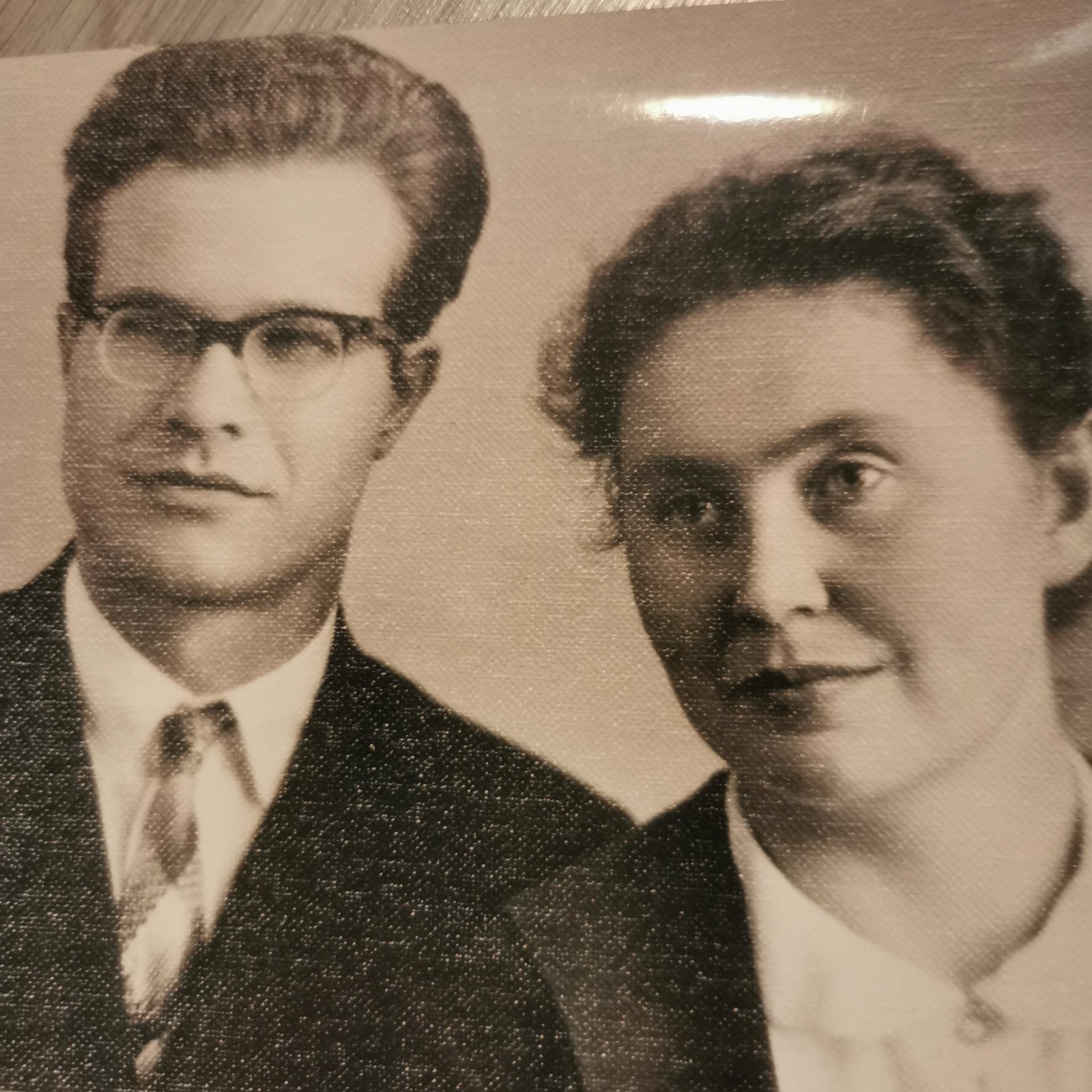 engineer in hydrotechny, married Alexeï Garinine. They had two daughters, Ioulia and Nina.
They live in Kazakhstan. We exchanged letters, after she received the booklet on the History of the d'Horrer that I had made. We invited each other, but without success.e. (DOC 30 : Letter from Olga Garinina, Tatiana d'Horrer's daughter (April 23, 1997)
2/ SOFIA (Sophie) Vassilievna d'HORRER, Vassili Luppov's daughter, born in 1948, geologist.
 Sofia and me in Bat-Yam (Israel),1995.
she searched for the d'Horrer family in France, wrote me and we could meet several times and correspond. (Letter from Sophie d'Horrer, July 15, 1993). She married successively Alexandre Kem, had a daughter, Valeria, then Leonid Geikhman, a Jew with whom she emigrated to Israel, in Bat-Yam, near Tel Aviv, where I was able to go see her. She then came to France to see us. Divorced again in 1995, she converted to Catholicism and became a nun at the Benedictine Abbey of the Mount of Olives, in Jerusalem.
NOTES
Contact
1/ T.O. : Tiloboié opoltchenié, untranslatable word that refers to a form of Gulag, without a court, akin to forced labor, where the soldier-prisoners worked at wells, logging operations and other "constructions of communism".