Return page In Russia (18/19th century)----Common lineage family tree
Next page: Marie-Joseph d'Horrer's children
The knight, then count MARIE-JOSEPH d'HORRER, said too d'HORRER de FORSTING or d'HORRER de REICHENBOURG de FORSTING (1) is the son of Philippe-Xavier d'Horrer and Marie-Reine Kien. He was born in Strasbourg on October 9, 1775 and baptized the same day. (Doc-11 : Birth certificate)
Barely 16 years old, he emigrated with his father Philippe (-Xavier) and his brother Philippe (-Léonard) on August 18, 1792 and joined the army of the Prince of Condé. He served first, with the approval of the Prince of Condé, as a volunteer in the Austrian army with which he conducted the campaigns of 1792 and 1793. Returned as a volunteer to 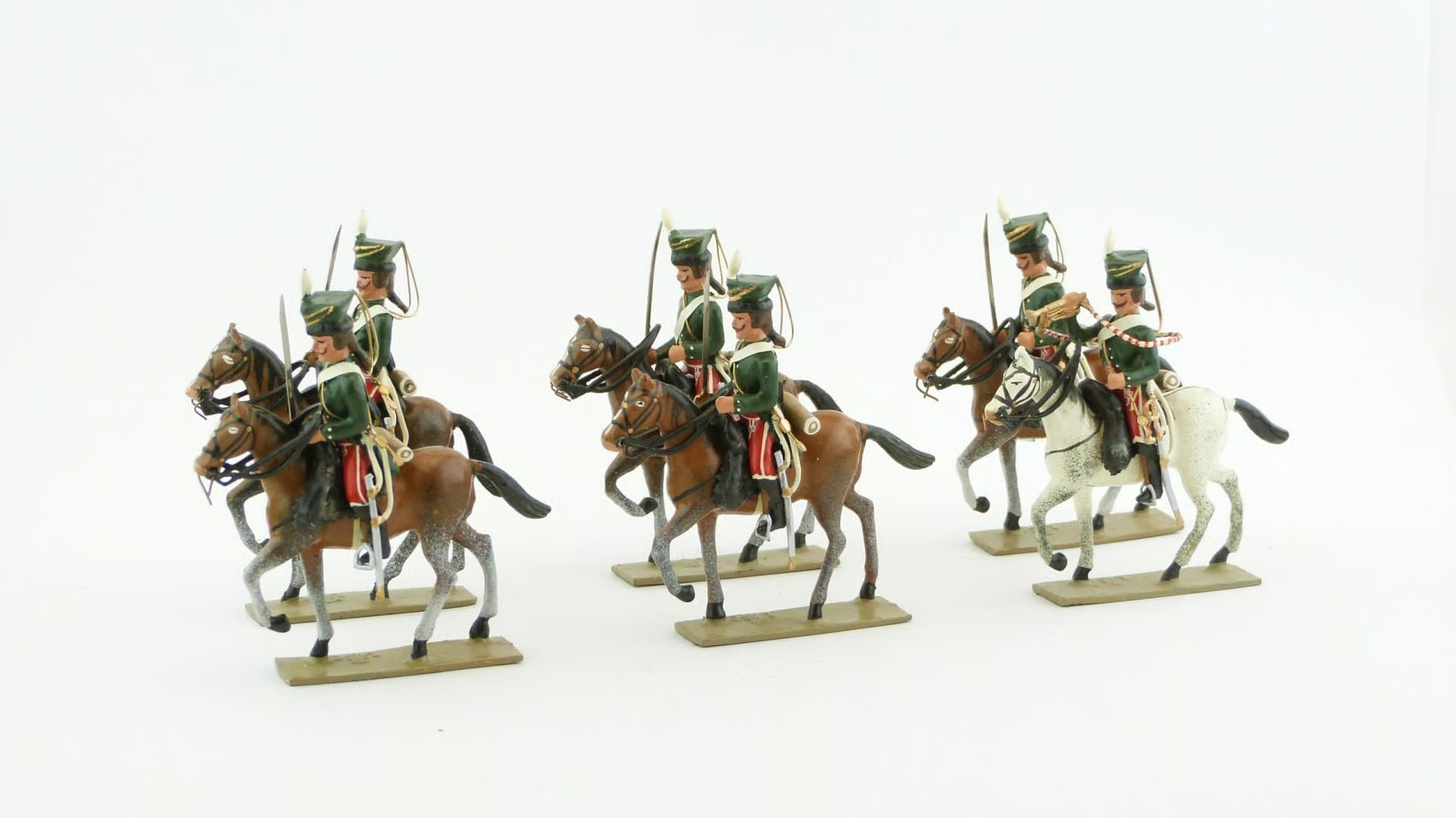 the Regiment of Hunters on horseback de Bussy(2) , he fought with this regiment in the 1794 and 1795 campaigns, and was wounded by a gunshot at the battle of Opladen on September 7, 1795. He joined the army of Condé on October 1, 1795 and served in the corps of the Knights of the Crown, with which he fought the 1796 and 1797 campaigns, then in the Noble Regiment on horseback, with which he entered Russia at the end of 1798.
He then asked and obtained, on September 24, his resignation to retire to Russia at the same time as a very laudatory certificate from the Prince of Condé, and he went to Saint Petersburg.
He then resolved to work to create an existence for himself in this country and, both through this work and as a result of an advantageous marriage, he acquired an estate in the province of Kiev where he lived when, after his victories at Jena and Auerstaedt, Napoleon threatened the borders of Russia. At that time, the Tsar formed a voluntary militia to which former officers were called.
Then Marie-Joseph d'Horrer entered the service of Russia, on September 1, 1806, as commander of the 1st battalion of the Volunteer Hunters of Kiev, a corps of 500 men that he had been tasked with organizing. He was sent to the army of Moldova with this small corps and campaigned with it from 1807 to 1810, until his dismissal (3) .
.On May 17, 1804, in Moscow, Marie-Joseph d'Horrer was a witness at the wedding of her sister Isabelle with Philippe-Germain de Galland. By commission from the Duke of Feltre, Captain d'Horrer, resident in Moscow, knight of Saint-Louis, was commissioned to receive as a knight of the same order his brother-in-law, Captain de Galland, which took place on 19 January 1818.
According to a letter from his grandson Vladimir d'Horrer (Russian branch) to his cousin Arsène d'Horrer (French branch), Marie-Joseph had been employed for secret correspondence. During the capture of Moscow by Napoleon in 1812, he could not flee in time, was seized and brought before a war commission chaired by general Davout. Davout ordered him to say everything he knew about the positions of the Russian army, the number of troops, etc. On his negative response, he would have wanted to have him shot. But he reversed his decision and sent him back as a prisoner of war. After many misadventures, Marie-Joseph managed to escape from Moscow with the help of some Cossacks, and went to find Marshal Kutusov, Prince of Smolensk, who, granting him unlimited confidence, often charged him with important commissions.
After the death of this marshal, he was appointed, on September 13, 1813, aide-de-camp to the director of the Military Channels and Communications of the Great Russian Army. In this capacity, he participated in the campaigns of 1813 and 1814 and found himself in particular at the battles of Bautzen/Wurschen and Leipzig (October 18, 1813) as well as at the battles of Kulm. He was appointed Captain of the Engineer, by order of the day in the army, for having particularly distinguished himself at Leipzig. At the end of the war, he obtained, as a reward for his services, the rank of Major of Engineering, equivalent in Russia to lieutenant-colonel.
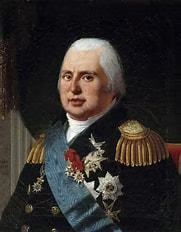
Although he was then attached to the Duke Alexander of Württemberg and found himself in a very advantageous position with the prospect of becoming general soon, he nevertheless eagerly obeyed, after the Restoration, the ordinance of the King Louis XVIII, who recalled the former officers to France. He obtained his resignation from the Russian service on June 5, 1816, provided with a particularly flattering certificate from General Louis de Carbonnier de Grangeac, director of military channels and communications.
Returned to France, he was appointed cavalry squadron leader by order of May 6, 1817 and appointed to the command post of the 3rd squadron of the Queen’s Cuirassiers regiment by order of the following August 3 (3).
But the Count of Noailles, French ambassador to Russia, insisted on him because of his perfect knowledge of the Russian language and country, so that he would be attached to his embassy. He was sent there as embassy secretary and interpreter on October 24, 1817.
Resigned on July 6, 1820, he was appointed embassy secretary in Switzerland. He provided reported services everywhere, and was responsible for very confidential negotiations in Fribourg. He successfully conducted the difficult negotiations of 1827 and 1828 between France and Switzerland. The capitulations of the Swiss regiments entered into the service of the king of Naples are due to him. In 1848 and 1849, these regiments had saved the crown of the king of the Two Sicilies. In his book on the Duchess of Berry, H. Thirria cites interesting letters that inform us about the actions of the royalist committee formed in Bern under the direction of Marie-Joseph d'Horrer.
The newspaper "L'Helvétie" reports: "The knight d'Horrer, former French embassy secretary in Switzerland, who had been ordered to leave Bern, is reported as the main Carlist agent in Switzerland. Before leaving this capital, he makes a big noise about a registration document : he says that it belongs to him and that he would like to be restored. The fact is that this document was issued to him by Mr. de Gabriac, former ambassador to Switzerland, when he was no longer in office. We can now see why Mr. d'Horrer is so keen on the return of this piece, which will be much better in the hands of the French government." (BNF, Journal des débats politiques et littéraires, September 18, 1832).
Several works speak of him as a distinguished historian of the secret societies, very familiar with Freemasonry in Switzerland, and he gave very interesting biographical details on the main characters of the Swiss revolution of 1848 and their links with Freemasonry. By way of example, we find a long and interesting quote from him in the book "Revolutions in France and in Europe".
He had already been appointed for some time as consul general in the Moldovan-Valaksh provinces, in Bucharest,(4) but had postponed his departure from Switzerland to complete the negotiations regarding the capitulation of the Swiss regiments in the service of Naples, which saved the crown of the Two Sicilies in 1827 and 1828. He was still in Bern during the French Revolution of 1830, which saw the accession of Louis-Philippe and the Orléans dynasty to the throne.
See : French historical context in 1830
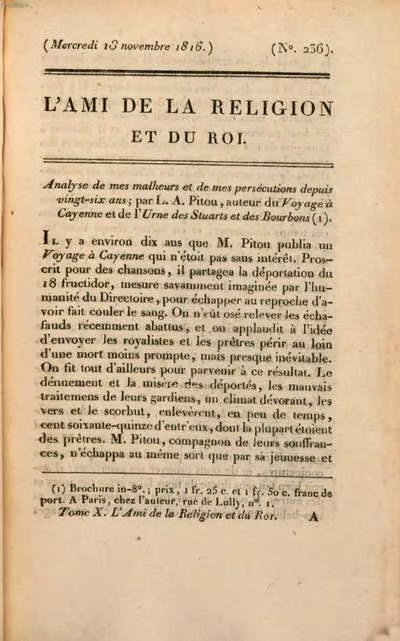 Deeply attached to the Bourbons dynasty, personally linked to King Charles X, now in exile, he refused to take the oath, was declared resigned, deprived of treatment, and had to resort to his pen to support his numerous family, first in Turin and in Russia, where he had left several children, then to Paris where, returning in 1842 and, resigned to the precarious fate that the revolutions had given him, he lived from his collaboration as a publicist for Catholic magazines and newspapers, notably L'Ami des Religions, where he was a specialist in the sufferings of the Catholic Church in the Northern countries and in Russia.
In 1843, he gave courses on German rationalist philosophy as part of a Catholic Institute whose members pledged allegiance to the Count of Chambord, a young Bourbon legitimist pretender to the throne.
Living 1, rue de Babylone, in Paris, he was swept away within few hours by the cholera epidemic on May 3, 1849. Because of the risk of contagion, he was buried very quickly and is reposed with his daughter Ernestine (who lived with his father and died from the same disease shortly after him) in the Montparnasse cemetery in the grave of a friend, Mr. J. Lambert de Frondeville, without mention of his name (5).
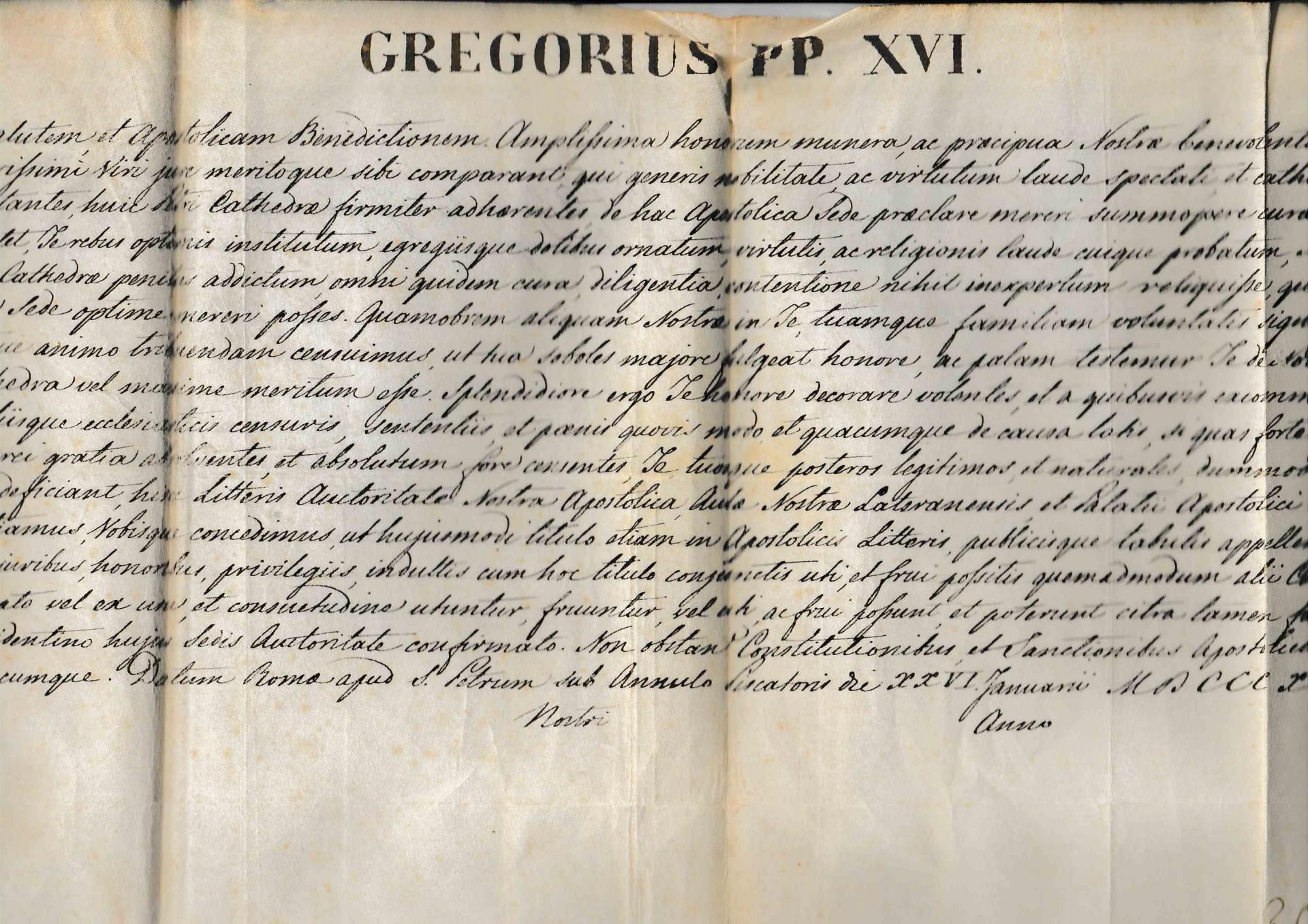 Knight of Saint-Vladimir of Russia (January 13, 1812), of the royal and military order of Saint-Louis (March 6, 1817) on the recommendation of the prince of Condé (see Doc-12 recommandation), of the Legion of Honor (November 4, 1828), knight commander of Saint Ferdinand and of the Merit of the Two Sicilies, authorized to accept and wear this decoration by authorization of the Grand Chancellor of the royal order of the Legion of Honour (February 11, 1829), knight grand-cross of the Militia of Jesus Christ authorized to accept and wear this decoration by royal decision of October 31, 1826, knight of the Golden Spur, he was created count, with transmission of the hereditary comital title to each of his three surviving sons (Philippe, Joseph-F-X. and Alexandre) by Pope Gregory XVI on January 25, 1836 (see Doc-13 : Gregory XVI's certificate), because of his dedication to the Holy See, his high moral value and the dignity of his whole life.
 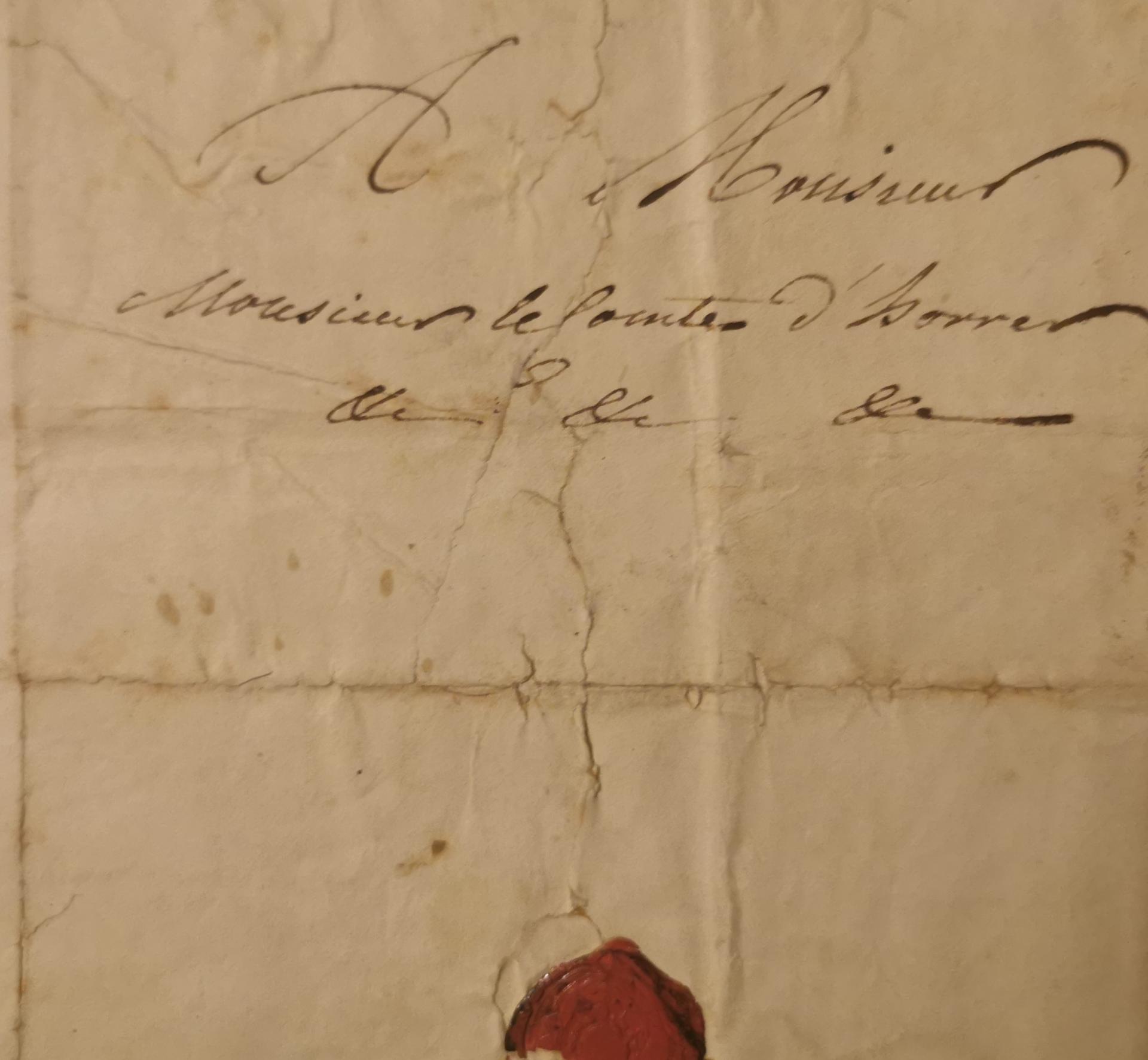 On April 30, 1836, Marie-Joseph d'Horrer confirmed this title by Charles X, the king in exile in Prague, but whom he continued to consider legitimate (see DOC-14 : King Charles X' confirm letter).
He united military bravery with a very extensive training and, apart from an ongoing collaboration in various periodicals and Catholic newspapers, he published several works, among which "Persecutions and sufferings of the Catholic Church in Russia, by a former State Councillor of Russia" (Paris, Gaume frères, 1842, 1 vol in-8°, National Library: M.30765) ; "Persecutions of the Catholic Church in Poland", "The Messiah", poem, new translation by M. J. d'Horrer, Paris, Egron 1825, 3 vol. in-8°, National Library YN 2892-2893) ; A translation (from German) of the book by Bishop Droste-Vischering, Bishop of Cologne: "On peace between Church and States", 1844, 1 vol in-8°, Nat. Lib. E.5904; "On the situation of the republic and canton of Geneva in its current conflict with the bishop of Lausanne and Geneva" (1844) (6) ; he is also the author of a French-Italian dictionary.
Marie-Joseph d'Horrer married in Kiev, Ukraina, on May 1, 1806, Emily-Wilhelmine de RACHETTE (1775-1833) (7) , from a Russian family of French origin who russified her name in Рашетт (same pronunciation), daughter of Jacques-Dominique de Rachette, state councilor and knight of the order of Sainte-Anne, and from Esther van Dokum. In the absence of a Catholic priest, this union was only contracted before the Lutheran pastor of Kiev, and they confirmed it in Saint Petersburg on May 20, 1811, at the Roman Catholic church of St. Catherine. Emily-Wilhelmine de Rachette died on March 16, 1833 in Moncaglieri (city of the Sardinian states very close to Turin), aged 45 years.
They had nine children, who follow:
NOTES
1/ On the marriage certificate of his son Joseph-François-Xavier in Saint-Petersburg, on January 11, 1840, he is qualified as "Count d'Horrer de Forsting".
2/ A Hunter on horseback is a type of military rider belonging to the light cavalry, generally responsible for reconnaissance missions and army lighting.
3/ On March 22, 1808, he received a pass to go to Vienna from Prince Prosorowski on which he is said to be "brigade major of the 2nd militia brigade of the Kiev Government".
4/ On his report of receipt into the order of Saint Louis, dated 24 October 1829, signed by his cousin Viscount Capriol de Saint-Hilaire, Marshal of the King’s Camps and Armies, commander of a brigade of infantry of the Guard, Marie-Joseph d'Horrer is described as "lieutenant-colonel of cavalry, consul of France in Bucharest."
5/ This tomb, where also rest J. B. Joseph de Morgan as well as members of the family of the counts de Beaumont, is in the 3rd division, 1st section, 4th line of the Roundabout.
6/ Biographical notes can be found in the "Grand Dictionnaire Larousse", the "Dictionary of Dictionaries" by Bishop Guérin; the "New Dictionary of History and Ancient and Modern Geography" by d'Ault-Dumesnil; the "Biography Dictionary of the Famous Men of Alsace" by Sitzmann; the 'Universal Biography' of Michault.
7/ de Rachette, Рашет, : family originally from Languedoc. Antoine-Jacques-Dominique (1744-1809) emigrated to Russia during the Revolution, and he was ennobled at the end of his life. His family was listed in the third part of the nobiliary registers (nobility acquired in civil service).