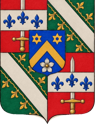
Pervitino is the estate of the Khvostov family, the family of Sophie, the wife of Joseph d'Horrer. It lies on the Kava river, about fifteen kilometres from Likhoslavl and some 70 km from Tver, north-west of Moscow.
From the Shishkovs to the Khvostovs
The village appears in the archives as early as 1742, when a wooden church was built there. At the end of the 18th century it belonged to Major Alexander Fyodorovich Shishkov, who had the stone Trinity church built from 1785 to 1794, consecrated in 1794: a Baroque building with Classical decoration, its dome painted with eight archangels1.
At the beginning of the 19th century the estate passed to the Khvostovs, close relatives of the Shishkovs. Its first owner from that family was the artillery captain Nikolai Petrovich Khvostov (1748–1829), churchwarden, who gave the church new bells and a stone fence whose four corner towers still stand. The estate then went to his son Arseny Nikolaevich (Arsène), a hero of the war of 1812, who died in 1830, and in 1837 to Nikolai Arsenyevich Khvostov, his only son and Sophie's brother2.
The Khvostovs' house
Nikolai Arsenyevich built the present manor house: a two-storey stone house in the Classical style, linked by glazed galleries to two wooden wings, finished in the 1840s. In front of the west front lay a parterre lined with silver poplars and lime trees; of the park running down to the Kava, a few old trees and traces of avenues remain. In 1863 the church received a carved and gilded three-tier iconostasis.
After 1917
In 1917 the family had to leave: the estate was confiscated and its property shared among the peasants. In January 1918 a commune settled there, and the manor house became a "people's house" with a club, a drama group and a choir. The church was closed and used as a storehouse by the commune and then the collective farm; its iconostasis and interior were lost. From 1931 to 2015 the manor house was the village school.
Since 1974 the ensemble — the house, the church and the four towers of the fence — has been protected as a monument of national importance. In 2018 a chapel was set up in the church and a service was held there for the first time in about a hundred years. The house is still waiting to be restored.
See the video The Pervitino estate (in Russian). The village's small local history museum, founded in 1981, gives part of its exhibition to the Khvostovs.
Notes
- 1Sources: the article « Первитино (усадьба) » of the Russian Wikipedia; the record « Главный дом усадьбы Первитино » of the Tver region's register of monuments; the recollections of Z. M. Matorina about the estate's last residents around 1900 are published in the book Из рода Хвостовых ("From the Khvostov family"), compiled by G. G. Ivanova (2003).
- 2According to the Russian Wikipedia article « Первитино (Лихославльский район) », Arseny Khvostov inherited Pervitino and all his father's property, valued at 100,000 roubles, by will, and owned the estate for only a year and a half; it then went to Nikolai Arsenyevich, then aged 19.